
Cosmic Darwinism for Embodied AI: A Free Upgrade Path for Optimus
Why forgetting, not more compute, is the missing ingredient

1. The real bottleneck in embodied AI
Embodied AI has reached a strange impasse.
On paper, robots like Tesla’s Optimus have access to:
enormous compute,
powerful neural networks,
high-resolution sensors,
world-class engineering.
Yet the gap between demonstration and robust autonomy remains stubbornly large.
This is usually framed as a hardware problem, a data problem, or a simulation-to-reality problem.
It is none of those.
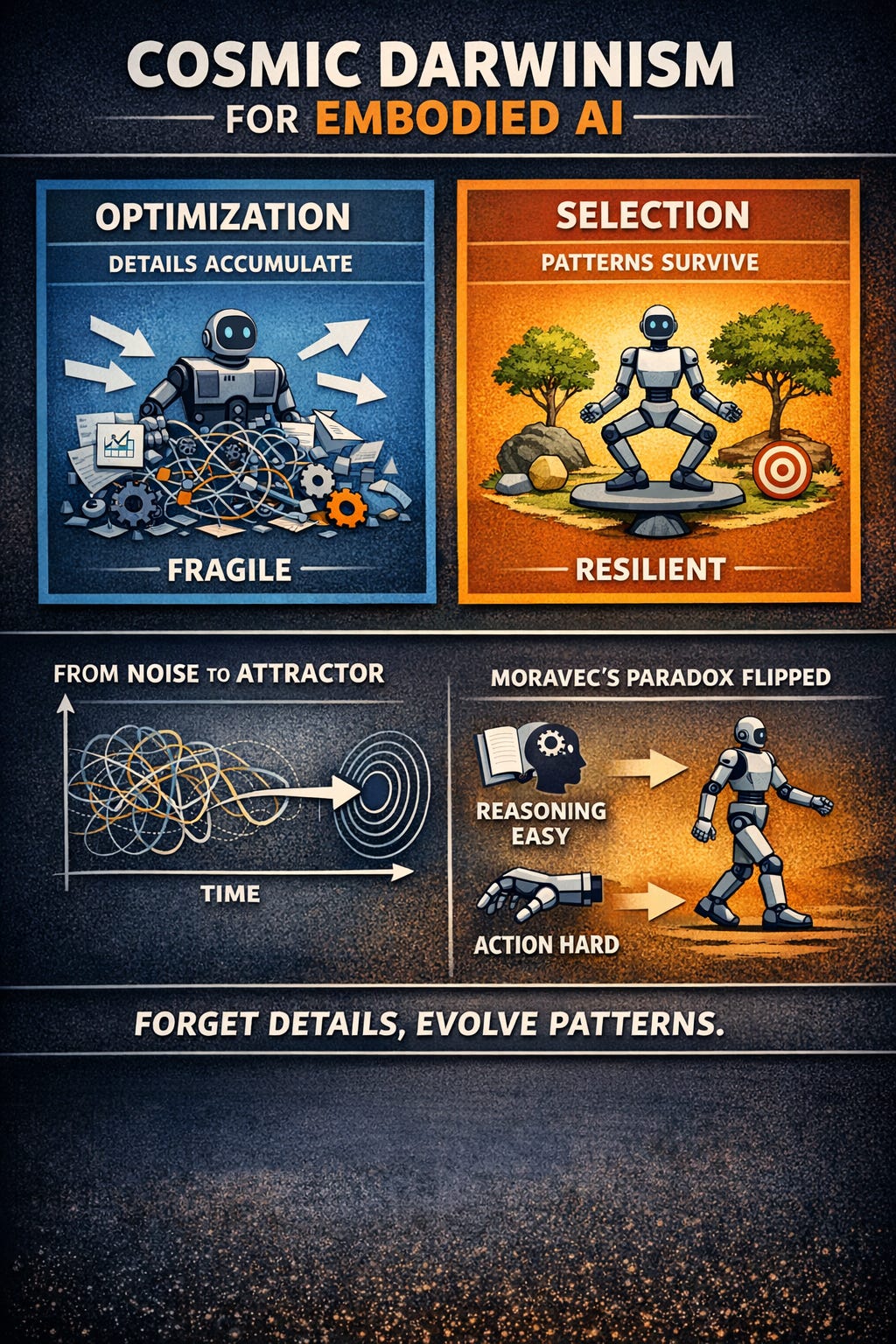
It is a selection problem.
2. Moravec’s paradox, properly understood
Moravec’s paradox tells us that:
abstract reasoning is easy for machines,
perception and motor control are hard.
This looks paradoxical only if intelligence is assumed to be optimization over symbols.
But intelligence is not optimized.
It is selected.
High-level reasoning operates inside already-stabilized cognitive attractors. Language, logic, and planning live on slow manifolds that have survived centuries of human filtering.
Sensorimotor intelligence does not.
It must create those attractors from raw interaction.
Embodied AI fails when it tries to optimize before selection has happened.
3. The human advantage is not precision, it is forgetting
Humans are remarkably bad at remembering details:
exact trajectories,
precise force profiles,
pixel-level states.
And remarkably good at remembering:
affordances,
invariants,
stable patterns.
This is not accidental.
It is Darwinian.
The human brain aggressively forgets fast, unstable detail and retains only what survives repeated interaction across contexts. Concepts, skills, and motor primitives are attractors that persist after enormous internal pruning.
Forgetting is not a limitation.
It is the mechanism.
4. Cosmic Darwinism as an engineering principle
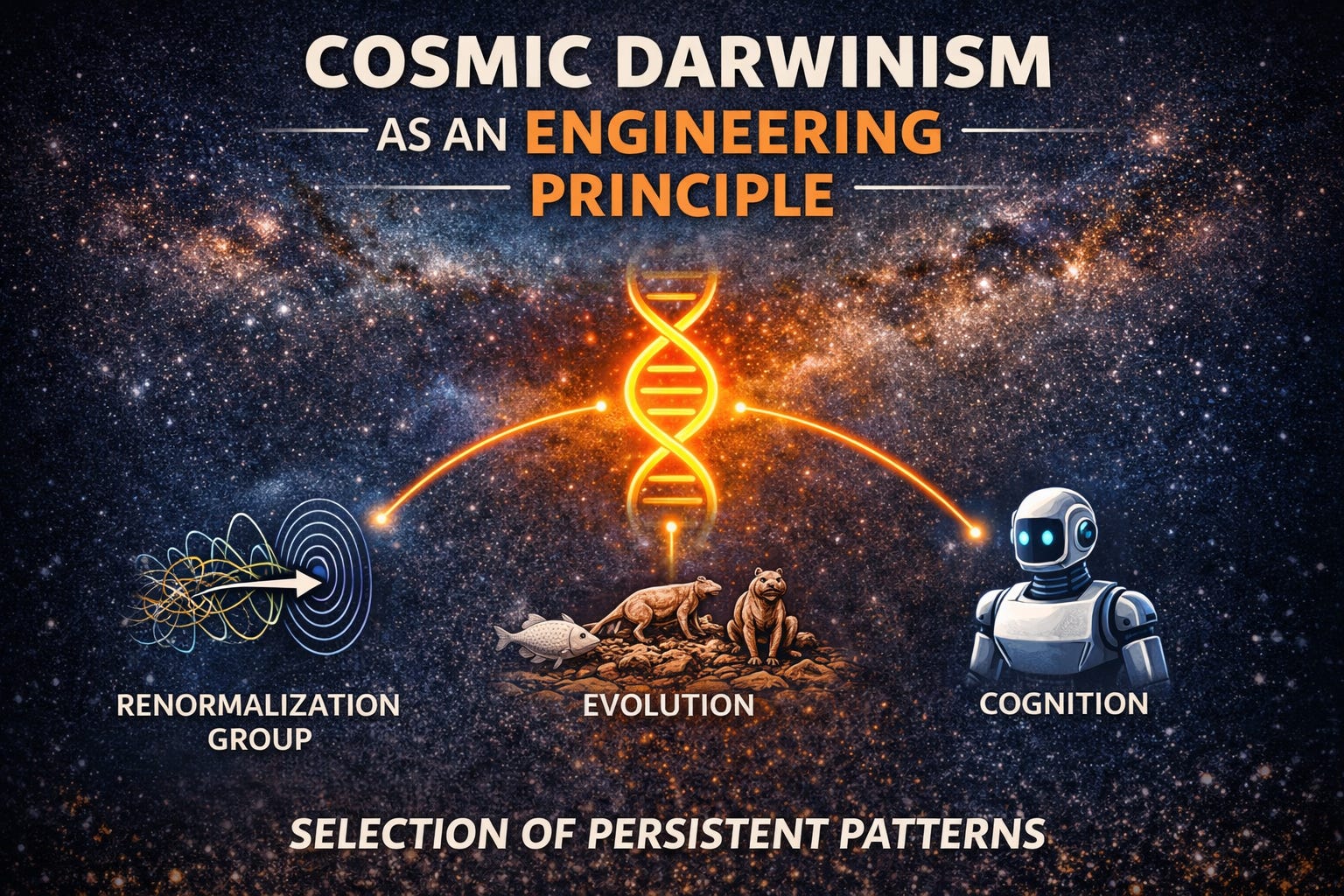
Across physics, biology, and cognition, the same pattern appears:
fast fluctuations die,
slow structures persist,
what survives defines reality at that level.
Renormalization Group flows, evolutionary selection, neural pruning, and cognitive abstraction are all expressions of this single principle.
This is cosmic Darwinism.
Embodied AI has so far tried to bypass it.
5. Why Optimus does not need a new brain
The surprising conclusion is this:
Optimus does not need fundamentally new models to improve dramatically.
It needs selection pressure, not more optimization.
Today’s control and perception stacks attempt to preserve too much detail. They accumulate brittle representations that look impressive in demos but collapse under small perturbations.
Humans do the opposite.
They discard almost everything.
6. A free upgrade path: selection over representations
Here is what a Darwinian upgrade path looks like, using existing architectures.
A. Enforce representational death
Internal motor and perceptual representations should decay unless they:
reappear across tasks,
survive perturbations,
recover after failure.
Most internal states should die quickly.
Only stable ones should persist.
B. Reward recovery, not accuracy
Instead of optimizing for:
trajectory fidelity,
imitation precision,
optimize for:
recovery after slips,
re-stabilization after occlusion,
return to task after interruption.
Humans are not accurate.
They are resilient.
C. Train invariants, not actions
A grasp is not a trajectory.
It is an invariant relationship between hand, object, and force.
Selection should favor representations that:
work across object shapes,
survive lighting changes,
tolerate noise and delay.
Exact motor commands are expendable.
Affordances are not.
D. Let skills emerge as attractors
Walking, grasping, balancing, tool use should be treated as dynamical attractors, not policies.
Once formed, they:
reassert themselves,
resist perturbation,
simplify control.
This is how biological motor intelligence works.
7. Why this avoids the Moravec trap
Moravec’s paradox persists because we confuse:
symbolic intelligence, which lives inside attractors, with
embodied intelligence, which must create them.
Cosmic Darwinism explains why language models scale smoothly while robots do not.
Optimus does not need better reasoning.
It needs to forget faster and stabilize slower patterns.
8. How this can be tested immediately
This is not philosophy.
You can take:
the same robot,
the same sensors,
the same compute,
and compare:
optimization-heavy training,
selection-heavy training.
Measure:
recovery time after perturbation,
skill persistence across tasks,
degradation under noise.
The Darwinian system will win.
9. The broader implication
Embodied AI will not be solved by:
larger models,
better simulators,
tighter control loops.
It will be solved by respecting the same principle that governs:
biological intelligence,
physical law emergence,
human cognition.
What survives matters.
What does not, must be forgotten.
Closing
Cosmic Darwinism is not a metaphor.
It is the reason intelligence exists at all.
Applying it to embodied AI does not require new theory or new hardware. It requires a shift in what we reward.
For Optimus, that shift is a free upgrade path.
The rest is engineering.